What to Include in a Brand Deal Contract (Creator's Guide)
Most creators have worked with brands on nothing more than a DM agreement and a handshake. For small deals with brands you trust, this sometimes works fine. For anything significant — anything over a few hundred dollars — it's a serious risk.
A contract protects both parties. It documents what was agreed, what happens if things go wrong, and who owns what after the content is published. Without one, you're relying entirely on goodwill — and goodwill doesn't hold up when a brand disputes a payment or decides they want to use your content in ways you never agreed to.
Here's what every brand deal contract should include.
The Core Elements of a Brand Deal Contract
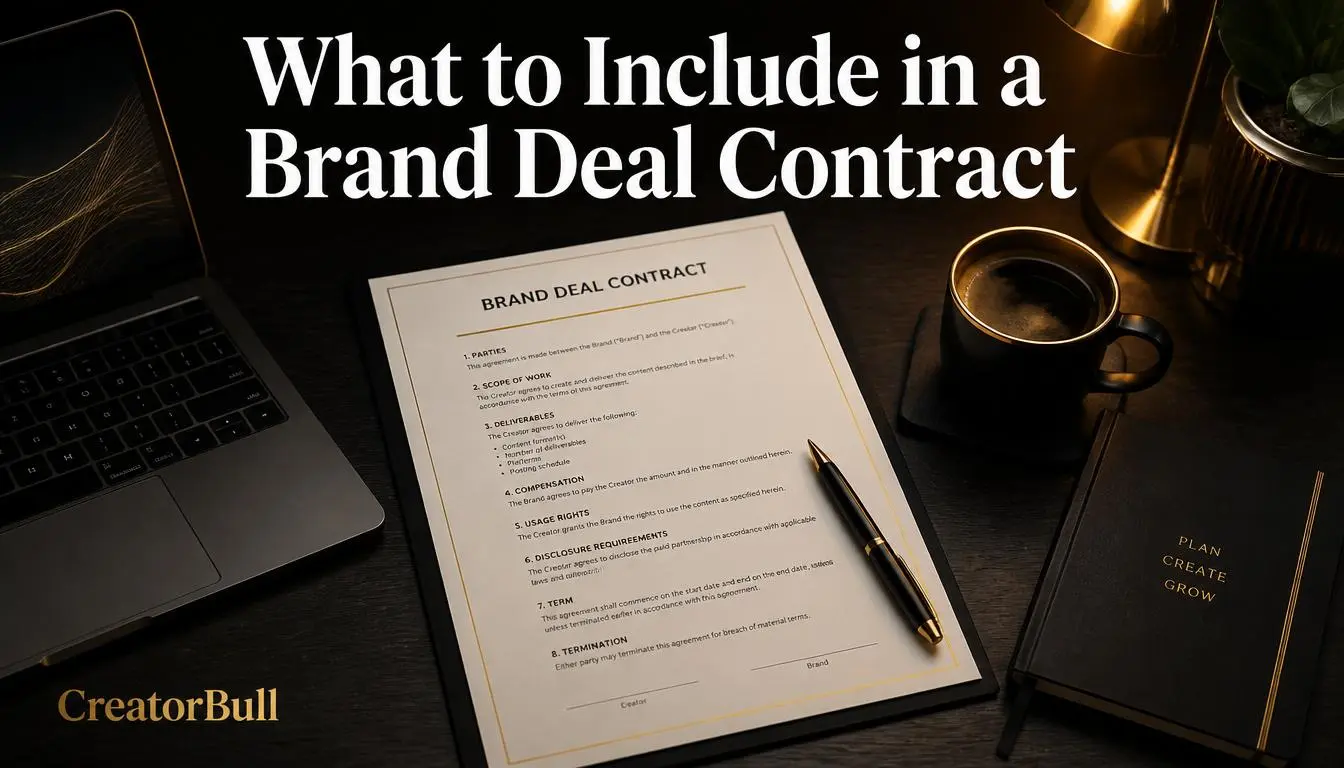
Parties involved — Full legal names of both the creator and the brand or agency. If you're working through an agency, make sure the contract names both the agency and the end brand client.
Campaign description — A brief description of the campaign, the product or service being promoted, and the overall objective. This sets the context for everything else in the contract.
Deliverables — This is the most important section. Every single piece of content you're being paid to create should be listed in specific detail. Not "Instagram content" — but "1 x Instagram Reel (60 seconds minimum, featuring [product], posted to @yourhandle feed on [date])" and "1 x Instagram Story set (minimum 3 frames with product link, posted within 24 hours of the Reel)".
Vague deliverables lead to scope creep — brands asking for more content, more revisions, more usage than you agreed to. The more specific your deliverables section, the more protected you are.
Timeline — When does the content need to be submitted for approval? When does it go live? How many rounds of revision are included (usually 1-2 is standard)? What's the turnaround time for brand feedback?
Compensation — The agreed fee, the currency, and the payment terms. Net 14, Net 30 — whatever was agreed. Include the payment method. If there's a deposit, specify the deposit amount and when it's due.
Approval process — Most brands require the right to review content before it goes live. The contract should specify how long they have to review (48-72 hours is standard), what the approval process looks like, and what happens if they don't respond within the review window.
Content ownership and usage rights — Who owns the content after it's published? By default, you as the creator own everything you produce. A brand deal contract should specify exactly what rights you're granting the brand and for how long.
Be specific. "The brand may use the content for organic social media posts for 30 days from the date of publication" is very different from "the brand has unlimited rights to use the content across all channels in perpetuity." The latter is extremely common in brand contracts and extremely harmful to creators who sign without reading carefully.
Exclusivity — Is the brand asking you not to work with their competitors for a defined period? If so, this needs to be explicitly stated in the contract — the duration, which brands or categories are excluded, and the additional fee you're charging for this restriction.
FTC disclosure requirements — Your contract should reference your obligation to disclose the paid partnership clearly on all content. In most markets this is a legal requirement. Use #ad, #sponsored, or the platform's native paid partnership label.
Cancellation and kill fee — What happens if the brand cancels the campaign after you've started creating content? A kill fee clause protects you in this scenario — typically 25-50% of the agreed fee if cancelled after brief approval, 50-100% if cancelled after content creation has begun.
What to Watch Out For When Brands Send Their Own Contracts
Brands and agencies often send their own contracts, which are written to protect the brand — not you. Here are the clauses to look for and push back on:
"In perpetuity" usage rights — This means the brand can use your content forever, across any channel, without paying you again. Always push back on this. Negotiate a specific time period and channel limitation.
Unlimited revisions — Some contracts include unlimited revision rounds. This can turn a single deliverable into weeks of back-and-forth work. Counter with a specific number — usually 2 rounds is reasonable.
Content ownership transfer — Some contracts try to transfer full ownership of your content to the brand, which means you can't even post it on your own channel without their permission. This is rarely what either party actually wants — usually they just want usage rights. Clarify and correct this.
Payment on 60 or 90-day terms — Net 60 and Net 90 are common in large corporate brands, especially in India where finance departments move slowly. If this is non-negotiable, at least ask for a 25-50% deposit upfront.
Non-disparagement clauses — You agree not to say anything negative about the brand, their products, or their competitors. Read these carefully — some are so broad they could prevent you from ever talking about a competitor's product in any context.
Do You Need a Lawyer to Review Your Brand Deal Contracts?
For small deals under ₹10,000 or $200, a lawyer review is probably overkill. For significant deals — anything over ₹50,000 or $1,000 — it's worth at least a one-time consultation with a lawyer who works with freelancers or creative professionals to understand what you're signing.
As your brand deal income grows, consider having a standard creator contract template drafted by a lawyer that you can use as the basis for negotiation with brands. This flips the dynamic — instead of reviewing their contract, you're sending yours.
Generate a Professional Brand Deal Contract in Seconds
You don't need to draft a contract from scratch every time. CreatorBull's contract generator lets you create a professional, branded sponsorship agreement as a PDF in under a minute — with all the key clauses already included.
Fill in your deliverables, payment terms, usage rights, and timeline. Download the PDF. Send it to the brand before you start creating anything. It's one of the simplest ways to immediately look more professional and protect yourself at the same time.
Free tool
Build your rate card in 3 minutes
Show brands your rates, past collabs, and social links — all in one shareable link.
Create yours free →Share this post