How to Invoice a Brand for a Sponsorship (Step by Step)
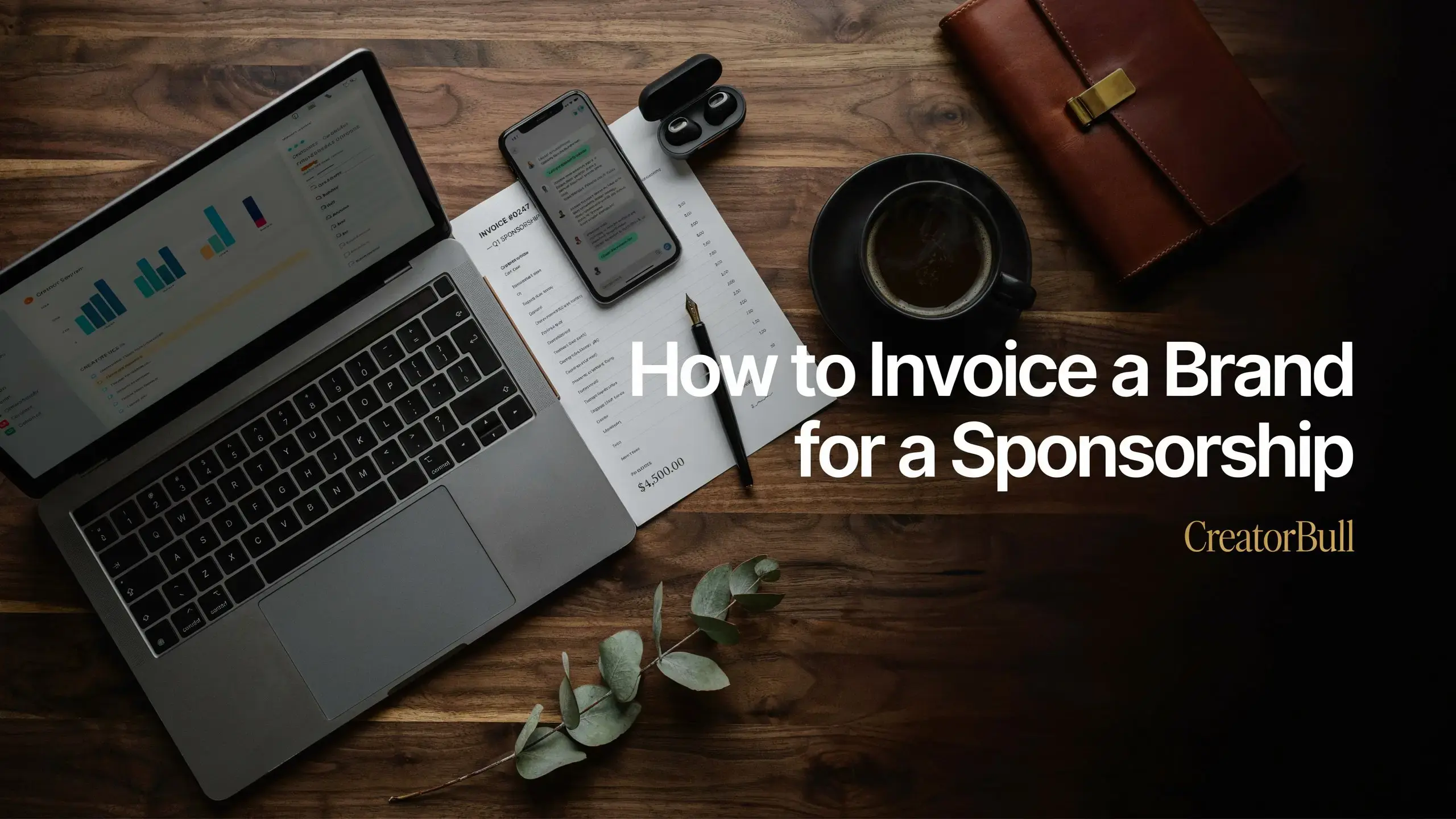
You just closed your first brand deal. The brief is agreed, the deliverables are set, and the brand has said yes. Now they're asking for an invoice — and you're staring at a blank screen wondering what that actually means.
This happens to almost every creator at some point. The brand partnership side gets a lot of attention. The business side — the invoices, the payment terms, the follow-ups — gets almost none. So let's fix that.
Here's exactly how to invoice a brand for a sponsorship, step by step.
What Is a Creator Invoice and Why Does It Matter?
An invoice is a formal payment request. It tells the brand exactly what you delivered, what they owe you, and when they need to pay it. It creates a paper trail that protects both you and the brand — and it makes you look professional in a space where most creators are still sending PayPal requests with "payment for reel" in the description.
Brands — especially larger ones — have accounts payable departments that require proper invoices before they can process any payment. If you don't send one, or if yours is missing key information, your payment gets delayed. Sometimes by weeks.
A proper invoice also protects you legally. If a brand disputes a payment or goes quiet, your invoice is evidence of the agreed amount and due date.
What to Include in a Brand Sponsorship Invoice
Every creator invoice should include the following:
Your name or business name — Whatever name you operate under. If you have a registered business, use that. If not, your full name works fine.
Your contact details — Email address at minimum. Some brands will also want your phone number or address if they're issuing a formal purchase order.
Invoice number — Start at 001 and increment with every invoice. This makes your records easy to search and looks professional to brands with formal billing systems.
Invoice date — The date you're sending the invoice.
Payment due date — Standard payment terms for creators are Net 15 (pay within 15 days) or Net 30 (pay within 30 days). Larger brands often default to Net 30 or even Net 60. Agree on this before you send the invoice.
Brand name and contact — Who the invoice is addressed to. Use the name of the marketing manager or the agency contact you've been working with.
Deliverables — A clear list of exactly what you delivered. For example: "1 x Instagram Reel (posted 14 June 2026)", "1 x Instagram Story set (3 frames, posted 14 June 2026)". Be specific. Vague descriptions cause disputes.
Amount due — The agreed fee. Include the currency. If you're an Indian creator working with international brands, specify whether the amount is in INR or USD to avoid confusion.
Bank details or payment method — How you want to be paid. Include your bank account details, UPI ID, or PayPal address depending on what you've agreed with the brand.
A Real Example of a Creator Invoice
Here's what a clean, professional creator invoice looks like in practice:
Invoice #007
Date: 14 June 2026
Due: 28 June 2026 (Net 14)
From: Your Name / @yourhandle
your@email.com
To: Brand Marketing Manager Name
Brand Name Pvt Ltd
Deliverables:
1 x Instagram Reel — Summer Collection Campaign (posted 10 June 2026) — ₹25,000
1 x Instagram Story Set (3 frames) — Summer Collection Campaign (posted 10 June 2026) — ₹8,000
Total Due: ₹33,000
Payment: Bank transfer to [your account details]
That's it. Clean, specific, professional. No design software needed.
Common Mistakes Creators Make When Invoicing Brands
Not invoicing at all. Some creators just send a bank account number and wait. Without a formal invoice, there's no agreed due date, no paper trail, and no professional pressure on the brand to pay on time. Always send an invoice.
Being too vague about deliverables. "Instagram content — ₹25,000" is not enough. List every deliverable with the date it was posted. If a dispute arises later, you want your invoice to be unambiguous.
Not including a due date. If you don't specify when payment is due, the brand can take as long as they want. Always include payment terms — Net 14 or Net 30 is standard for most creator deals.
Sending the invoice to the wrong person. The marketing manager you worked with may not be the person who processes payments. Ask who to address the invoice to before you send it. It's usually someone in finance or accounts payable.
Not following up. Brands are busy. A payment sitting in someone's inbox unpaid is often not malicious — it's just fallen through the cracks. If you haven't been paid by the due date, send a polite follow-up the next day. Most payments get processed quickly after a reminder.
How to Follow Up on an Unpaid Invoice
Following up on unpaid invoices is awkward for most creators. It doesn't have to be. A simple, professional email gets the job done without damaging the relationship.
Here's a template that works:
"Hi [Name], I wanted to follow up on Invoice #007 for the [Campaign Name] collaboration, which was due on [date]. Please let me know if you need anything from my end to process this. Happy to resend the invoice if helpful. Thanks so much!"
Keep it warm, keep it brief, and always reference the invoice number and amount. If a second follow-up is needed after another week, you can be slightly more direct while still remaining professional.
Should You Send the Invoice Before or After Posting?
This depends on what you agreed in the contract. Most creator deals work on one of two models:
Invoice after posting — The most common model. You deliver the content, then invoice once it's live. This is standard for one-off deals.
50% upfront, 50% on delivery — More common for larger deals or new brand relationships where you want some payment security before you start. If you're working with a brand for the first time and the deal is significant, it's completely reasonable to ask for a deposit.
Invoice before posting — Less common but happens with some brands, especially international ones who need longer payment processing times. Agree on this upfront if it's the case.
Do Creators Need to Register a Business to Invoice?
In India, if your brand deal income is below the GST threshold (currently ₹20 lakhs per year for most service providers), you can invoice as an individual without a GST number. Above that threshold, you'll need to register for GST and include your GSTIN on invoices.
For international brand deals, you can generally invoice as an individual with no additional requirements, though you may need to provide a W-8BEN form if you're working with US brands who need to process foreign vendor payments.
When in doubt, speak to a chartered accountant who works with freelancers — the rules are fairly straightforward once you understand them.
The Easiest Way to Invoice a Brand as a Creator
You can build your own invoice in Google Docs or a Word document using the structure above. That works fine when you're starting out.
As your brand deal volume grows, though, manually creating invoices becomes a real time drain — especially when you're tracking which ones have been paid, which are overdue, and what your total income looks like across the year.
CreatorBull's invoice generator was built specifically for creators who work with brands. Every invoice is automatically numbered, tracks its own payment status (sent, viewed, paid, overdue), supports multiple currencies for international deals, and exports as a clean PDF you can send directly to the brand. The whole process takes under a minute.
Your brand deal pipeline and your invoices are connected in one place — so when you mark an invoice as paid, your deal moves to closed automatically. No spreadsheet needed.
Get started free at CreatorBull — no credit card required.
Free tool
Build your rate card in 3 minutes
Show brands your rates, past collabs, and social links — all in one shareable link.
Create yours free →Share this post